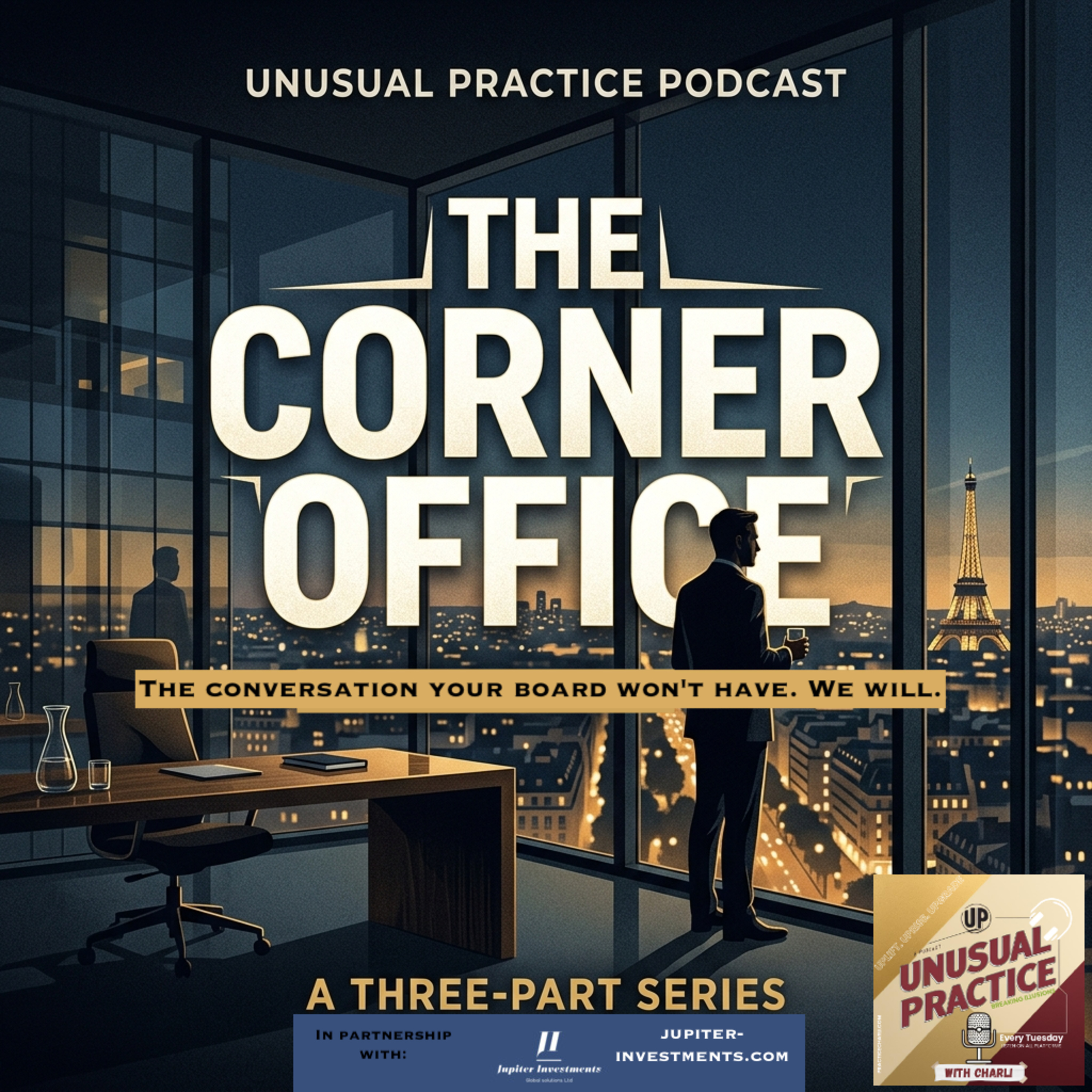
Sovereignty vs Success: Why you build an empire but lost the keys - part 3/3
There's a specific kind of disorientation that only comes with real success: you built the thing, you run the thing, and somehow the thing is running you.
This episode dismantles the psychological trap of accumulated success- the slow drift from a life you designed to a subscription you're paying with your autonomy, and why the higher your status, the harder it becomes to notice the cage.
Pulling from behavioral research on CEO identity capture, the philosophy of wei wu wei, pre-colonial African concepts of personal authority, and documented patterns in how successful institutions eventually imprison their founders, this is the episode for the leader who has everything on paper and can't shake the feeling that none of it was quite what they meant to build.
The keys aren't lost. But finding them requires going into a room most leaders have been avoiding for years.
Visit our hub: https://unusualpractice.carrd.co Other site: https://unusualpractice.podview.com Main site: https://practicecharli.com
Support this podcast at — https://redcircle.com/unusual-practice/donations
Roger, Charlie, we're ready to rock. There's a moment, and if you've built something real, you know exactly what I'm talking about. Where you're sitting in a meeting about your own company, about decisions you should be making, about a direction you originally set. And then you realize somewhere around the third agenda item that nobody is actually asking you.
Yeah, they're informing you. The structure runs, the machine hums, the calendar is full, and you are functionally a very well compensated passenger on a train you built, but you no longer drive. I guess congratulations is in order. You succeeded so thoroughly that you made yourself totally optional.
Welcome to the Corner Office by the Unusual Practice where we take the things that are going beautifully wrong in your business and career, and we talk about them like adults who are slightly tired of being lied to. I am your host, Charlie, and today we're cracking open something that nobody puts in the Forbes profile, but everybody with a big enough operation eventually feels the moment you realize the life you're living was designed by your ambition and not by you. There's a specific flavor of disorientation that comes with this.
It's not failure. It's not burnout. It's stranger than both of those. It's the feeling of standing in a house you built, in rooms you chose, surrounded by people you hired, and quietly wondering how you became a guest in all of it. We're calling it what it is today, the sovereignty problem, and we're going to go all the way through it.
Let me start with a word that doesn't get used enough in business conversations. And I use it very often and you've seen a series of it and it's called the arrangement. Not strategy, not vision, not execution road map, but arrangement. Because what most high performing leaders have built is not a company so much as a set of arrangements with investors, staff, clients, with market narrative, with their own self-image that have quietly calcified into obligations. And obligations over time start to feel suspiciously like a life sentence with a very good benefits package.
The question that most leaders never stop to ask is whether wealth, status or identity have replaced freedom, meaning and values, and whether they're in control of their success or actually controlled by it. There's a distinction worth drawing here between these two types of success. There is something called the design success, where you built something and deliberate alignment with what you actually wanted. The company is an expression of choices you made consciously, with real trade-offs understood upfront.
Then there's something called the accumulated success, where you moved fast, said yes to the right things, impressed the right people, and woke up one day inside a structure that you technically own but functionally serve. Most leaders with a decade or more on the clock have the second kind, not because they were careless, but because the machine requires maintenance before meaning, and maintenance compounds faster than reflection. Does the philosopher Simone Weil, who turned down a life of French bourgeois comfort to work in factories and eventually die of self-imposed conditions?
She had interesting thoughts on obligation, and she wrote, attention is the rarest and purest form of generosity. What she meant was that most people give everything except their actual presence. They give time, money, effort, everything. But the concentrated act of noticing what is really happening, and what's really happening in a lot of C suites right now is that the leader is running a subscription they didn't consciously sign up for. They're paying with their autonomy monthly, and the renewal is automatic.
But here's what makes this a bit fascinating and rather than just depressing, because the arrangement doesn't appear overnight, it's not a trap that snaps shut. It's more like, I don't know, wallpaper. You don't notice it going up, you just notice one day that you can't see the wall anymore. Now, here's the part that requires some real honesty, because it's kind of counterintuitive. The more functional your organization becomes, the more it develops its own immune system, its own gravity, its own logic about what decision looks like, what leadership looks like, what success looks like, all of which was seated by you early on and has since grown beyond the original plan.
Research on CEO organizational identification found that incumbent CE OS tend to believe their eventual successors should be just like them. But more remarkably, that commitment to the status quo was found to be positively related to the firm's current performance. So the better the company is doing, the more the leader commits to keeping things exactly as they are. Makes sense, right? Success is the anesthetic. It numbs a signal that says something needs to change because every external indicator says things are working, Revenue is up, team is stable, the brand has traction.
There is genuinely no emergency. Which is precisely why nobody questions that arrangement. In 15th century Florence, the Medici banking dynasty built the most sophisticated financial network Europe had ever seen. At its peak, the Medici had branches across 14 countries, served 3 popes, and effectively financed the Renaissance. And then gradually, over about 40 years, the structure that made them powerful became the structure that consumed them. Branch managers who had too much autonomy made too many bad loans.
The family's social obligations required generosity that drained the reserves. The very network they built started making decisions that the family in Florence could no longer see, let alone control. Lorenzo de Medici, brilliant, celebrated, politically untouchable, died at 43. The bank collapsed within a decade, not from conquest or scandal, but from the quiet weight of an institution that had outgrown any single person's ability to hold. He built an empire, and the empire ran him. Discover insights on business growth, leadership challenges, and human impact with unusual practices.
Insightful 3 part Corner office series. Unlock transformation at the very top. Listen now. Reshape your perspective on true success now you are not a 15th century Florentine banker. Probably my guess, but the structural dynamic is identical. When the thing you built becomes complex enough, it develops its own agenda and the people inside it quite rationally begin managing it rather than managing you. Because the structure is more durable than any individual, and everyone with a job can feel that.
There's a specific psychological state that emerges from this, and it's distinct enough that it deserves its own name. One of James's clients had worked since she was 15, supporting herself and later building her own company. When she finally restructured her business, hiring a team, building systems, creating leverage, she achieved what she thought she wanted. Time, freedom. But it didn't feel good. She felt guilty, restless, and lost. The more smoothly things ran without her, the more she wondered if she still mattered.
Burnout is exhaustion from too much. This is something closer to obsolete, the feeling of being technically present but functionally redundant in your own structure. Psychologists call the broader pattern the arrival fallacy, a term coined by Harvard researcher Taliban Shahar to describe the persistent human belief that reaching a goal will produce lasting satisfaction, followed by the bewildering discovery that it doesn't. You arrive, you look around, and the thing that was supposed to feel like a destination looks from the inside, remarkably like a departure gate.
Ladies and gentlemen, this is your captain speaking. But in the context of sovereignty, of leaders who built real things, the arrival fallacy has a sharper edge. Because it's not just that achievement didn't produce the feeling they expected, it's that the achievement produced a role, a set of expectations, obligations and performances that now needs to be maintained, whether or not it still fits who they actually are. The status is real, so is the reputation. The responsibilities are real. But the person underneath all of it has been on autopilot for three years and nobody put that on the agenda.
The Indian philosopher Jido Krishamurti, who was literally groomed from childhood to be a spiritual world leader, spectacularly walked away from the role at 34. And one of the more, shall we say, startling acts of self, sovereignty and modern history, he said. It is no measure of health to be well adjusted to a profoundly sick society. So let's transpose that slightly. It is no measure of success to to be well adjusted to a structure that was never actually designed for your life. So here's where this goes from a philosophical observation to an actual operational problem.
Because the leader who's been managed by their own structure doesn't just feel bad, they make measurably worse decisions. And most of the time, nobody around them is positioned to say so. So for that, let's talk about what this costs in practical terms. Because it's not abstract, the allure of financial security, prestige, and social validation can mask the emotional and psychological costs of staying in an unfulfilling role. These external rewards can easily drown out the quieter signals from within, the growing fatigue, the shrinking motivation, the subtle disconnection from who you used to be.
Over time, it starts to feel like a performance instead of purpose. Here's the transaction that nobody names explicitly. You trade sovereignty for significance slowly, voluntarily, and with excellent justification at every step. The first year, you give up some personal time because the company needs you reasonable. The third year, you give up a strategic direction you believed in because the board needs consensus. Understandable. The 5th year. You give up the version of the company you originally imagined because the market needs something slightly different.
Practical. The 8th year you're not sure what you originally wanted, but the quarterly numbers are good so each trade made sense. The cumulative effect is that you now run a company that is successful by the metrics of everyone except the person who started it. Oh shit. There's a Mallory concept, Mana, that doesn't translate cleanly into English, but refers to something like personal authority, spiritual power, and or the earned right to act from one's own center. It's not status. Status can be given.
Mana is generated from inside and can only be lost, not taken. The Maori understanding is that a leader who operates against their own mana, who consistently acts from obligation rather than conviction, doesn't just feel bad, they diminish. The energy drains and eventually so does the capacity to lead at all.
This is not mysticism, that's a pre industrial cultures incredibly precise observation of something modern psychology would later quantify as the difference between intrinsic and extrinsic motivation. With a century of research confirming that people operating from extrinsic pressure rather than internal alignment burn now faster, decide worse, and build less, The subscription costs more than it looks like on the invoice. So if you're somewhere in the middle of recognizing yourself in this, here's what I want to offer.
Of course not a framework or a six step protocol, but a set of honest reorientations. Let's call them. The first one is sovereignty is not about walking away. This is where people misread the problem and throw everything out. The issue is not the company, the issue is the gap between the company's logic and the founders original intent. And that gap actually can be closed, but only if someone first acknowledges it exists. The Ottoman architect Sinan, who built over 300 structures, 300 structures in the 16th century, including the Suleimani Mosque in Istanbul, which is still standing, was famously given total creative authority by Sultan Suleiman.
Not because Suleiman didn't care, because he understood that a person who who's operating from genuine autonomy built something different and better than a person executing someone else's instructions. The Sultan gave Sinan the keys. Sinan built things that lasted 5 centuries. The question is, do you still have yours? The second reorientation, Decision audit. Not soul searching. This is actually practical. Go back through the last six months of significant calls. For each one, I want you to ask a single question.
Was this decision made by me from my actual values and judgment, or was it made by me in service of the structure? Not every structure serving decision is wrong, but if the ratio is entirely 1 sided, the machine is running the meeting and you're just approving the minutes. The 3rd and this is the one that actually hurts. Redesign is not a sign of failure. It is historically the signature move of people who build things that last. The Medici who saved what remained of the family name didn't double down on the original banking model.
He redirected into art, patronage, political philosophy and agriculture, not retreat redesign. He took back agency by changing the terms of the arrangement on his own timeline, rather than waiting for the structure to collapse around him. The high achievers paradox reveals A systemic trap, not a personal failing. What follows is the need for an operating manual, for understanding why the very machine that built your success is now keeping you stuck. The machine isn't evil, it's actually indifferent.
It will run with whoever's hand is on the lever. The question is whether that hand is yours, consciously, deliberately, on terms you chose, or whether it's just there because it got there first and nobody's thought to ask. Since there's an old House of proverbs from West Africa. However long the night, the dawn will break. People quote it as reassurance, but I think there's something a bit more precise in this because it doesn't say the dawn will come find you, it doesn't say the dawn will make things comfortable.
It just says the night, however long eventually ends. What you do with the morning is a separate question entirely. A lot of leaders are in a very well decorated night right now. The lights are on, the revenue is there, the brand is solid. From outside it looks like high Noon, but internally in that quiet place that doesn't make it to the board deck, there's a question they haven't answered yet. Did I build this for me? And if not, whose life am I running exactly? That question doesn't have a 32nd answer, but the fact that it's asking itself persistently at like 4:47 AM.
Don't ask me why I'm hooked on that number or in the third hour of a strategic planning off site is not a problem to fix. It's actually an invitation. The keys are not lost, they're just in a room you haven't been in for a while. All right, so if this episode hit different, first of all, you're welcome. And also I'm sorry. And also, that was the whole point. If you're sitting somewhere between, this is fine. And wait, is any of this actually mine? Is this me? Well, that's the exact conversation we help people have.
Don't forget to like and subscribe. Not in a therapy adjacent way, in a very direct no agenda. Let's actually figure out what you want kind of way. Also, if you've been listening to the show and haven't left a review yet, I need you to understand that reviews are how more people find this. And more people finding this means more CE OS having mildly uncomfortable Tuesday mornings, which is a public good. So do it. And subscribe.
Until next time, stay curious, stay sovereign, and watch out Who's meeting you're actually running. Somebody just followed me. Unusual practice. Rethink what you think you know.
 Apple Podcasts
 Castbox
 Castro
 Goodpods
 Moon FM
 Overcast
 Pocket Casts
 Podbean
 Podcast Addict
 Podcast Republic
 Spotify
 YouTube