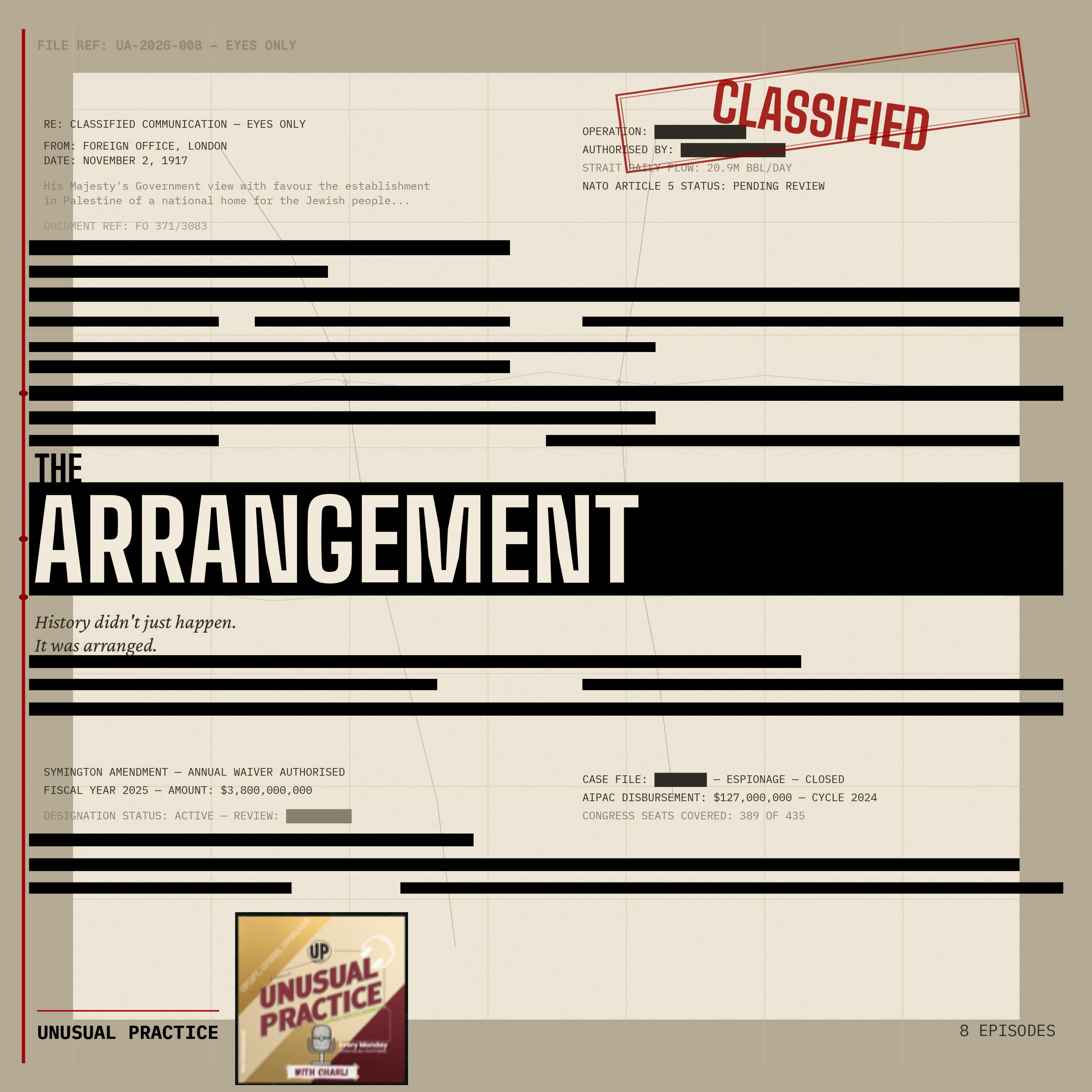
The Arrangement - The Patient (Part 7/8)
Part 7 of 8. Russia has not fired a missile. China has not moved a soldier. Neither has spent a dollar on this conflict.
Both of them are winning.
The most dangerous player in any conflict is the one not fighting, because they have already calculated how it ends.
In this episode of The Arrangement, a special 8-part series from Unusual Practice, we examine the patient strategy: how Russia profits from every barrel of disrupted Middle Eastern oil, how China has built energy independence from three sanctioned nations at below-market prices, why the sanctions designed to contain America's adversaries are inadvertently enriching them, Turkey's extraordinary multi-vector foreign policy that nobody in Western media discusses seriously, and the structural evidence that what we are watching is not a war America is winning... but a symptom of a decline it is accelerating.
Sources:
1. Russia oil revenue as % of federal budget — IMF Russia Article IV
https://www.imf.org/en/Publications/CR/Issues/2024/russia-article-iv
2. China's sanctioned oil imports — Russia, Iran, Venezuela 33% of mix — S&P Global
https://www.spglobal.com/commodityinsights/en/market-insights/latest-news/oil/china-crude-imports-sanctioned-nations
3. China Belt and Road Initiative scope — World Bank
https://www.worldbank.org/en/topic/regional-integration/brief/belt-and-road-initiative
4. Turkey S-400 purchase, F-35 suspension — NATO / US Department of Defense
https://www.defense.gov/News/Releases/Release/Article/1876821/
5. UN report on Uyghur human rights situation in Xinjiang
https://www.ohchr.org/en/documents/country-reports/ohchr-assessment-human-rights-concerns-xinjiang-uyghur-autonomous-region
6. America's share of global GDP decline — World Bank data
https://data.worldbank.org/indicator/NY.GDP.MKTP.CD
7. Two-state solution made structurally impossible — UN OCHA West Bank report
https://www.ochaopt.org/location/west-bank
Visit our hub: https://unusualpractice.carrd.co Other site: https://unusualpractice.podview.com Main site: https://practicecharli.com
Support this podcast at — https://redcircle.com/unusual-practice/donations
The most dangerous player in any conflict is the one not fighting. Roger, Charlie, we're ready to rock. Not because they are peaceful, because they have already calculated how it ends and they are simply waiting for the people fighting to finish paying the bill. This is the most unusual practice. We think what you think you know with Charlie, no. Fights never done.
Since February 28th, 2026, the day United States and Israeli forces began strikes on Iran, Russia has not fired a missile at anyone involved in this conflict. China has not moved a soldier, and neither has issued A meaningful diplomatic statement that carries any real cost. Russia's oil revenue is up, China's strategic position in Asia has strengthened, the American dollar is under pressure, NATO is fractured, and the countries bearing the highest economic damage from this war, South Korea, Japan, Germany, India, are all American allies.
Nobody, and I mean nobody planned this better than the people who did not show up. Welcome back to the arrangement. I am your host Charlie, and this is episode 7 we entitled The Patient. Like, comment and subscribe.
Now, before I go further, I want to be very clear about something. This episode is not an argument that China and Russia are good because, well, really they're not. Both are authoritarian states with documented records of suppressing their own populations, invading neighbors, and pursuing imperial ambitions of their own fine. Russia invaded Ukraine. China has systematically oppressed or Igor Muslims and Xinjiang in a campaign the United Nations called a serious human rights situation requiring urgent attention.
Neither country is presented here as a hero, OK. What they are presented as is what they actually are, in this specific context, the most strategically patient actors in a conflict they did not start and are profiting from enormously. That is not admiration. That is an honest assessment of the board Russia's economy runs on. Hydrocarbons, oil and natural gas account for approximately 45% of Russia's federal budget revenue. When oil prices rise, Russia's financial position strengthens. When oil prices fall, Russia contracts.
The Strait of Hormuz closure drove global oil prices up sharply. Russian oil, which exits through Baltic and Arctic ports entirely unaffected by the Hormuz closure, became simultaneously more valuable and more essential to buyers who could no longer access Middle Eastern supply at pre war prices. India, which had been quietly increasing Russian oil imports since 2022 at deeply discounted prices, faced pressure to absorb even more Russian supply when its Gulf alternatives became unreliable. Japan and South Korea, facing Hormuz driven shortfalls, began emergency negotiations for Russian LNG from Sakalan Island, projects they had been attempting to exit for geopolitical reasons since the Ukraine invasion.
The countries trying to isolate Russia financially were forced by a war in a completely separate region to deepen their dependency on Russian energy. The sanctions architecture built over three years to contain Russia was partially dismantled in three weeks by the consequences of a conflict Russia had nothing to do with. And geopolitically, Russia's position in the narrative has shifted. For three years, Russia was the global pariah, the invader of Ukraine, the violator of European sovereignty, the subject of unprecedented Western sanctions.
The Middle East war has not erased that, but it has diluted it. The world's attention, The diplomatic bandwidth, the financial and military resources of the Western alliance, all of it has been partially redirected. Ukraine's support has become more difficult to sustain politically. In Washington, the unified Western Front that emerged after February 2022 has developed fractures that Russia has every incentive to deepen. Russia did not orchestrate any of this. It's simply positioned itself to benefit from instability it knew America's own behavior was likely to produce.
That is not genius. That is more like patience combined with a clear understanding of how American foreign policy creates its own contradictions. China's strategy in this conflict is a bit more sophisticated than Russia's and operates across a longer time horizon. To understand it properly, you need to understand what China is actually building and how this war serves that construction. You see, China is building an alternative to the American LED global order, not in one dramatic move, but systematically, patiently, across multiple domains simultaneously.
In energy, China has built the most sophisticated sanctioned oil import network in history. Russia, Iran and Venezuela, three countries under American sanctions combined, provided 33% of China's crude import mix in 2024. All at significant discount. All outside the dollar denominated global oil market. China is building energy security that is structurally independent of American financial leverage in currency. China has been systematically building the infrastructure to settle international trade in Wan, the Belt and Rd.
initiative. China's trillion dollar global infrastructure investment program spanning 140 countries is partly about physical infrastructure and partly about creating financial relationships denominated in Chinese currency. Every country that accepts a Chinese built port or railway and repays the loan in one is 1 more country that no longer exclusively needs dollars in technology. Well, China controls approximately 60% of global rare earth production and 85% of processing capacity. The technology of the next century, electric vehicles, advanced military systems, renewable energy infrastructure, all runs on materials China controls.
Greenland's deposits, if America acquired them, would reduce that dependency. China's diplomatic and economic relationships with Arctic nations and its formal status as a near Arctic state are partly designed to complicate that scenario in diplomacy. In March 2023, China brokered A diplomatic normalization agreement between Saudi Arabia and Iran, two countries that had not had diplomatic relations since 2016. This was not a humanitarian gesture. It was a demonstration of capacity. China was showing the Middle East and the world that it could do what America had historically done, broker regional arrangements.
The message was precise. You do not need Washington as your only patron. The Middle East war has accelerated every one of these trajectories. American credibility in the region has fractured. Arab states that we're moving toward normalization with Israel are under domestic pressure to reverse course. The dollar's dominance faces new questions as allies absorb economic shocks that American policy decisions created. And China, which positioned itself as a neutral diplomatic actor, gains influence in every room that America has left in anger or chaos.
Most people are watching the war, a few are trying to understand it. This series is for the second group, 8 episodes. Every thread connected all sourced the arrangement only on unusual practice. Now check this out. There is one more player in this landscape that almost nobody in Western media discusses with the seriousness it actually deserves, and that is Turkey. Turkey is a NATO member. It hosts American nuclear Weapons air base under NATO's nuclear sharing arrangement. It controls the Bosphorus Strait, the waterway connecting the Black Sea to the Mediterranean, giving it veto power over Russian naval movements from its Black Sea Fleet.
It is the second largest military in NATO by personnel. It is, on paper, one of America's most strategically important allies. However, it is also simultaneously a major purchaser of Russian natural gas. The operator of the Turk Stream pipeline that carries Russian gas to Europe. A buyer of Russian S 400 missile defense systems which got Turkey suspended from the F35 program. A vocal critic of Israeli military action with Erdogan calling it genocide. A country that has shot down a Russian military jet and the normalized relations with Russia regional power with documented neo Ottoman ambitions and the primary drone supplier to Ukraine in the war against Russia.
Yep Yep. Turkey is not confused and Turkey is not inconsistent. Turkey is conducting the most sophisticated multi vector foreign policy of any mid sized power in the world. Erdogan has understood something that most western analysts refuse to acknowledge. The era of block loyalty is over kaput. Every country now has the option, and increasingly the necessity, of managing relationships with multiple competing powers simultaneously. In the context of this war, Turkey's position is critical for one specific reason.
You see, Jordan's Hashemite monarchy sits directly in the crosshairs of Erdogan's neo Ottoman vision because the Hashemites were the family removed from Arabia by the Saudis and from the broader regional leadership role by the collapse of Ottoman authority. Erdogan, who has positioned himself as a champion of Palestinian rights and Muslim solidarity, represents an alternative poll of Sunni Muslim leadership that challenges Saudi Arabia. It undermines the Hashim at Jordan and complicates every existing regional arrangement.
Turkey is the wild card that could determine whether this conflict expands into a full NATO crisis. Because if Turkey uses this moment to advance its own regional agenda, it does so as a NATO member, with American nuclear weapons on its soil and with the ability to close the Bosphorus to Russian naval traffic at any moment. That is not a small card. That is the hound that changes the entire game. So here's the hardest truth of this episode, and possibly of this entire series. Every action America is taking right now in the Middle East, in Latin America, toward Greenland and Panama and NATO, is consistent with the behavior of a declining empire attempting to arrest its own decline through force.
This is not a partisan statement. It is actually a historical pattern. The British Empire in its final decades became more aggressive, not less, fighting wars in South Africa, Egypt, India and Iraq to maintain a dominance. That economic and demographic reality was already eroding. The Ottoman Empire in its final century grew more violent towards its own minorities as external pressure increased. The Armenian genocide was partly a product of imperial paranoia in a collapsing state. Rome, in its final centuries expanded its military commitments beyond its economic capacity to sustain them.
America's share of global GDP has declined from approximately 50% at the end of World War 2 to approximately 25% today. Its manufacturing base has hollowed out. Its infrastructure ranks poorly against peer competitors. Its political system has become increasingly dysfunctional. Its dollar, while still dominant, faces the first serious structural challenge to its reserve currency status since Bretton Woods. An empire in confident ascent does not need to threaten Denmark over Greenland. It does not need to demand Panama return a canal it legitimately received.
It does not exempt 1 country from every law while threatening allies who disagree. These are not the actions of a power at its peak. These are the actions of a power that can feel the ground shifting and is reaching for whatever it can grab before the balance tips. China and Russia understand this. They are not trying to defeat America in a direct confrontation because they simply don't need to. They only need to wait to continue building alternative infrastructure, financial, diplomatic, technological, military, to continue absorbing sanctioned oil at discounts that strengthen them while weakening the sanctioners, to continue demonstrating in every region that there is an alternative patron available.
Unusual practice. We read the studies you pretend to quote. We question everything, especially the experts. It's the show that does the research so you don't have to, and saves you from another Ted Talk while we're at it. Unusual practice. We're thinking's still a thing. The Middle East war is not the cause of American decline. It is a symptom of it, and it is accelerating it. Every dollar spent on weapons sent to a conflict that benefits primarily an arms industry. Every ally alienated by economic shocks created by American policy decisions.
Every room that America leaves in anger, that China walks into quietly every year this continues, is a year that the alternative architecture becomes more established, more credible, and more capable of functioning without American approval. There are things that every serious analyst of this conflict understands that appear in academic papers and classified assessments and private diplomatic communications that are almost never said publicly by anyone with power or a platform to lose The two state solution for Israel and Palestine, the framework that has been official American, European and UN policy for decades, has been made structurally impossible by Israeli settlement expansion.
The lounge required for a viable Palestinian state no longer exists as contiguous territory. The solution being publicly endorsed is one that privately everyone in the room knows cannot be implemented that Iran's nuclear program. The stated justification for this war was not, according to the IAEA own assessment on the eve of the strikes, constituting an organized nuclear weapons program. The threat was real in potential, yes. It was not proven, in fact at the moment the bombs fell, that regime change, not nuclear containment, was the actual objective of the February 28th strike.
No serious military analyst believes a bombing campaign eliminates a nuclear program without eliminating the government pursuing it. The target was always the regime. Khamenei was killed in his home compound. That is not kudos to anyone. The Iranian people, who were protesting against their own government in the largest demonstrations since 1979 are now under foreign bombardment, more likely to rally behind that government than to rise against it. Foreign bombs have historically been the most effective tool for saving unpopular governments from their own populations.
It happened in Serbia in 1999. It happened in Iraq. It is happening in Iran that the arms industry, whose profit depends on conflict continuing, has more consistent, sustained influence over American foreign policy than any elected official, any lobbying organization, or any foreign government. Because it employs people in every Congressional District. Because its stock price is watched by every pension fund. Because its campaign contributions are legal, documented, and perpetual. None of this is a secret.
All of it is documented. The gap is not between what is known and what is hidden. The gap is between what is known and what is said. That gap is what this entire series has been designed to close. Like, comment and subscribe.
Russia profits without fighting. China builds without rushing. Turkey plays every side with extraordinary precision. America reaches for everything it fears losing, accelerating the very decline it is trying to arrest.
And the people dying in Lebanon, in Gaza, Iran, Yemen and Iraq are not part of anyone's strategic calculation. They're the cost column that nobody reads aloud. Every source in this episode is documented and LinkedIn the description. Episode 8 is going to be our last episode. We're going to say everything that this series has been building to word. Break your night, chase a. Light every thread, every damn silence, every question that power does not want you to ask. And then, because this series would be incomplete without it, we're going to talk about you, the person listening.
What do you do with all of this? Because information without direction is just noise. And this series was created out of love for life. I don't want the little. Skies, but we rely through it all.
We thank you for listening to Unusual Practice as your host, Charlie, please subscribe, follow, like, and definitely comment. And don't forget to play along with our polls. Until then. This was the arrangement because history did not just happen, it was always arranged. Mom, somebody just followed me. I'll be back. OK, I feel the beat. Drums of hope under our feet everything will love belongs.
 Apple Podcasts
 Castbox
 Castro
 Goodpods
 Moon FM
 Overcast
 Pocket Casts
 Podbean
 Podcast Addict
 Podcast Republic
 Spotify
 YouTube