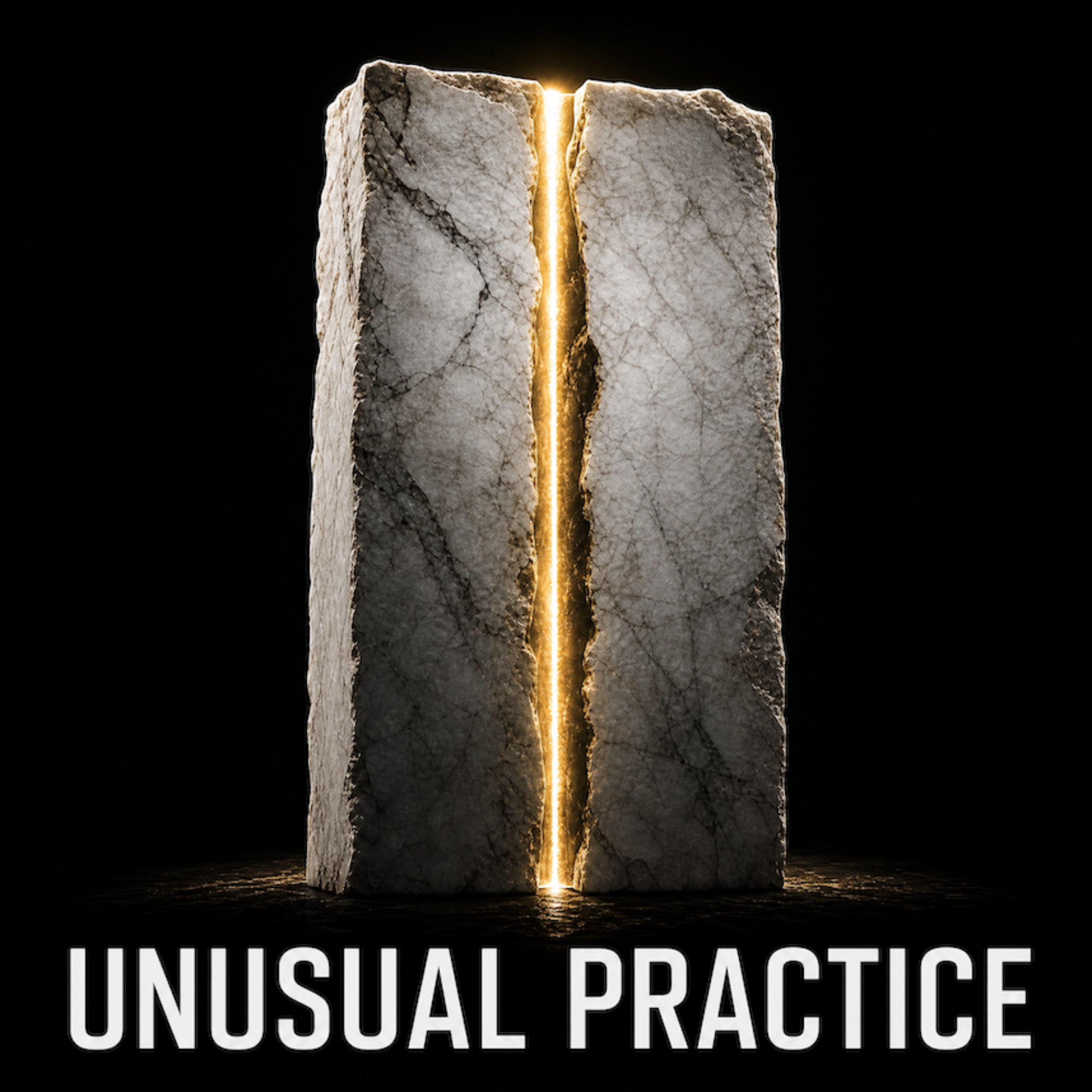
Who Owns December 25? The Strange Birth (and Rebirth) of a Holiday No One Can Claim
Christians didn't invent December 25. Pagans didn't own it first. And the "War on Christmas"? It's been raging for 2,000 years.
The Gospels never mention when Jesus was born. Early Christians didn't celebrate Christmas for 300 years. Sohow did December 25 become the most fought-over date in human history?
Perfect for anyone who loves history deep dives, religious mysteries, and darkly funny takes on sacred cows.
⚠️Warning: Might make your next family Christmas dinner very interesting.
Happy Holidays then?
#Christmas #History#ChristmasOrigins #PaganChristmas #WinterSolstice #HolidayHistory #December25
Visit our hub: https://unusualpractice.carrd.co Other site: https://unusualpractice.podview.com Main site: https://practicecharli.com
Support this podcast at — https://redcircle.com/unusual-practice/donations
Roger, Charlie, we're ready to rock. It's somewhere in Scandinavia around 3000 BCE. You're cold, you're hungry, and the sun, the sun is literally dying. Not like, oh, I feel a bit seasonal depression coming on, but dying? Oh my God. Like actual measurable, terrifying dying. Did you get that? Every day, a little less light, a little more darkness, until you're down to about four hours of week anemic sunshine that barely cuts through the fog, and you're starting to think maybe the gods have just given up on us.
So naturally, you do what any reasonable person would do when faced with potential cosmic abandonment. You throw a rager, you burn the biggest log you can find. You slaughter a pig. Sorry, pig. And you get absolutely hammered on Mead, and you make a very drunken promise to the sun that you'll be so much better if it just comes back. And The thing is, it works every single year. It works, really. Welcome to unusual practice where forgotten rituals meet modern insight. I'm Charlie, your guide. Stay with me and I'll walk you right into the fire.
Like, comment and subscribe. Fast forward a few thousand years. December 25th. Christians around the world are celebrating the birth of Jesus Christ. Church services, Nativity scenes. Your aunt's increasingly unhinged Facebook posts about the war on Christmas. Except here's the thing that's going to make this a bit awkward. Nobody, I mean nobody actually wrote down when Jesus was born. What? I like you. Do you like?
Me. Not Matthew. Not Luke, not even John, the guy who was so into symbolism he wrote an entire book featuring Dragons, trumpets and seven headed beasts that sound like it was designed by a committee. Nothing 0 Zilch. You see the earliest document that even mentions December 25 as Jesus birthday, 336-CE. That's 300 years after the fact. That's like someone in 2025 deciding your mom's birthday is now Cinco de Mayo because the vibes just felt right and the whole family rolling with it. Like yeah, she does look like Tequila gave birth to her.
Now here's where it gets spicy. Today, if you say Happy Holidays instead of Merry Christmas, well, there's a decent chance someone's going to write a strongly worded letter about how you're part of the secularization of Christmas. Excuse my Rs how corporations and liberals are stealing Christmas and taking it all back from Christians. But, and a big but, if we're being honest about history, and I mean actually honest, the stealing started way before your situation. Ship started borrowing your hoodie and somehow your dignity with it.
Because December 25 wasn't just sitting there unclaimed waiting for Christians to discover it like some kind of calendar real estate. People were already partying on that date and they had been for thousands of years, you know, party like a Diddy party so. Yeah, that's your. Son, now let me make something crystal clear. This episode is not about debunking faith. It's not an attack on Christianity or a defense of paganism, and it's definitely not going to solve the Happy Holidays debate. Sorry, that's kind of above my pay grade.
This is about something way more messed up and actually way more human. Whatever do you mean what happens when a date just a random spot on the calendar becomes a battleground, claimed, reclaimed, borrowed, branded and fought over like its territory that somebody somewhere must own? Because the story of December 25 involves desperate farmers? Imperial politics, theological math that would make your high school teacher weep, and one very stubborn Roman sun God who refused to go quietly into the night.
So stick around, because who owns December 25 might be the most contested copyright claim in human history. And the spoiler alert, nobody's won it yet. Unusual practice. We read the studies you pretend to quote. We question everything, especially the experts. It's the show that does the research so you don't have to, and saves you from another Ted Talk while we're at it. Unusual practice where thinking's still a thing. OK, so before we get into the religious drama, and trust me, there's plenty of religious drama, we need to talk about why humans started caring about late December in the 1st place.
And the answer is simpler than you think. We were scared. You see, for Stone Age people, winter wasn't just annoying cold weather season. It was legitimately terrifying Days getting shorter, food running out, animals dying, and every single day the sun rising a little later and setting a little earlier. And now you have to understand, these people didn't have Neil deGrasse Tyson explaining orbital mechanics. They didn't know the sun was coming back. For all they knew one day it just wouldn't. So around 10,200 BCE, just a little bit of date so we can get this going, humans started building monuments, not to gods, not to kings, to the sun specifically to mark the exact moment it started coming back.
New range in Ireland, Micho in Scotland, massive stone structures with corridors precisely aligned so that on the winter solstice, a single beam of sunlight would penetrate deep into the chamber like a cosmic. You've got mail notification that said congratulations, you've survived, the sun is coming back. And when that day came, they partied. Archaeologists found evidence near Stonehenge of massive feasts happening around the winter solstice. We're talking huge amounts of pigs and cattle bones, animals that were born in spring and killed nine months later right at solstice.
They weren't just marking the calendar. They were throwing a thank God we're not all going to die festival, which honestly sounds like a way better theme than the ugly sweater parties we do today. But here's what is strange. This wasn't just happening in Britain. This was everywhere. In ancient Albania, people lit collective fires to give strength to the sun. The Christian clergy spent literal centuries trying to stop them. It didn't work. People were like, yeah, cool story, father, we're still lighting the fire In Persia.
They celebrated Yalda Night, staying up all night eating pomegranates, reciting poetry, honoring the sun God Mithra's triumph over darkness. The Inca fasted for three days, then used a mirror to focus the sun's rays and light a sacred fire. The Maya built El Castillo at Chichen Itza so precisely that on December 21st the sun creates a shadow that looks like a serpent crawling up the side of the pyramid, like an ancient laser light show. But with more math and I suppose less. Pink Floyd anthropologist Takishi Inomada from the University of Arizona puts it simply.
The cycle of planting and harvesting was closely tied to the solar cycle. The solstice is an important marking. Translation. If you didn't know when to plant crops, you died. So yeah, people paid attention to the sun. Now here's where it gets weird. December 25th isn't actually the winter solstice today. The solstice happens on December 21st, or the Day of the Greats, which would be my birthday. December 22nd. Hit Hit. If you want to send me a card, I won't exactly hate you for it, but let's move on.
So why does everyone care about December 25th calendar drift. When Julius Caesar created the Julian calendar in 46 BCE, the winter solstice did fall on December 25. But the Julian calendar had a tiny little math problem. It calculated the year as 365.25 days, when it's actually 365.242199 days, which basically meant every 128 years the calendar fell behind by one day. So by the time Christianity showed up, December 25th wasn't the solstice anymore. It had drifted to the 21st. But in people's minds, December 25 was still the day the sun returned.
It was branded locked in the date you threw the party. And when the Romans decided to make it official and throw a massive empire wide celebration for their sun God, well, they picked December 25. And when Christians a few centuries later needed to pick a date for Jesus's birthday, well, the date was already taken. Emotional damage. So here's the part that's going to make your Sunday school teacher quite uncomfortable. New body, and I mean new body in the early Christian Church gave a single down about Jesus's birthday.
I'm sorry, what? Yep, the Gospels don't mention it, not the date, not even the season. Matthew and Luke tell us about the birth Manger, shepherds, Maggie, the whole pageant. But when that's gone, radio silent. And for the 1st 300 years of Christianity, Christmas literally was not a thing. Not celebrated, not discussed, not on anyone's liturgical calendar. Why? Because early Christians thought birthday parties were Pagan. I'm serious. Origin of Alexandria, one of the most influential theologians of the 3rd century openly mocked Romans for celebrating birthdays.
He called it a Pagan practice. He literally said. Not one from all the Saints is found to have celebrated A festive day or a great feast on the day of his birth. The Jewish historian Josephus backed him up. The law does not permit us to make festivals at the births of our children, and thereby a fornication of drinking to excess. Think about that. The people who actually knew Jesus, his followers, the early church, the ones writing letters and getting martyred, didn't throw birthday parties because in their world, birthdays were what other people did.
Pagans, Romans, people who worshipped emperors and made-up gods. The early Christians cared about one thing, the resurrection, Paul straight up said. If Christ has not been raised, our preaching is useless, and so is your faith. Nobody cared when Jesus was born. They cared that he died and came back, which, to be fair, is a way more impressive party trick than just having a birthday. So how do we go from birthdays are Pagan nonsense to December 25 is the most important date in Christianity? Well, there are two theories, both fascinating and both, of course, kind of messy.
And depending on who you ask, one involves theological math and the other involves cultural theft. So let's start with the nerds. It's a perfect storm theory. One the spreadsheet Christians. Around the year 200 CE, some Christian scholars decided to figure out when Jesus was born using math. Not historical records, not eyewitness accounts, Math. Their logic went like this. Jesus was perfect. His life was cosmically symmetrical. Therefore he must have been conceived on the same day He died, March 25th, which early Christians believed was the date of the crucifixion and also the vernal equinox.
So they did the math. Conception on March 25 + 9 months of pregnancy equals December 25. Boom, birthday solved. A theologian named the Hippolytus of Rome around 202 AD explicitly wrote that Christ was born on December 25. Not because of pagans, not because of politics, but because of theological numerology. Kind of ancient spreadsheet energy, if you will. Now, this theory is rooted in Jewish scriptural numerology, which is a fancy way of saying Christians were trying to map cosmic perfection onto a calendar and they genuinely believed they figured it out.
These are the same people who spent decades arguing about whether Jesus had one nature or two natures. So honestly, calculating his birthday with math checks out. But here's where it gets complicated. Because while Christians were doing cosmic calculus, the Romans were doing something way more fun. They were throwing a massive party. Are you ready for the sun? Which takes us to theory #2 the imperial party crashers IN274-CE Emperor Aurelian, a guy who loved the sun so much he basically made it Rome's official God, instituted a festival called Dias Natales Solis Invicti Translation Birthday of the unconquered Sun date December 25th.
Aurelian built a massive temple to Sol Invictus. He held 30 chariot races. He elevated the sun God to one of the premier divinities of the empire, and the symbolism was perfect. December 25, right after the winter solstice, marking the moment when the sun starts getting stronger. Light defeating darkness. The unconquered sun being reborn. Now Christianity at this time was still relatively small, and it was competing with very popular cults. Sun worship was huge. Mystery religions were huge. Christians were the underdogs, so the theory is popularized by scholars in the 18th and the 19th centuries is that Christians strategically chose December 25 to piggyback on an existing festival.
You can't meet the Son of God's party, therefore you join it, rebrand it, and slowly convert the sun worshippers by giving them a new guy to celebrate on the same day. It's cultural leverage. Marketing strategy. 5th dimensional chess. Basically. Early Christians invented the concept of hijacking the algorithm. But here's the plot twist. We're not actually sure the pagans had the date first in the first place.
The Chronography of 354, which is the earliest document that mentions any Pagan God being celebrated on December 25th, also mentions Christians celebrating Jesus birthday on that same date. Meaning we have evidence that Christians recognize December 25 as Christmas in the two hundreds AD. Which might mean that December 25 Christmas predated Aurelian's Soul Invictus holiday. So maybe Christians have the date first and maybe the pagans copied them. Or maybe, and this is what makes historians pull their hair out, everyone was celebrating on or around December 25 for different reasons, and the records are so thin and politically biased that will genuinely never know who was first Brad.
But what we do know for sure is that Christmas was first documented in Rome in 336-CE. By that point it was official locked in December 25 was Jesus birthday this. Is going to be the coolest party ever. Whether that date came from theological math or from strategic cultural appropriation, or both, we don't actually know. But here's what matters. It wasn't chosen because someone had a birth certificate. Nobody did. Not the Christians, not the Pagans, not the sun worshippers. December 25 was chosen because humans needed a date, a marker, a day to say this is when light returns.
And if you're going to pick a day for that, the day the sun starts coming back is certainly not a terrible choice. Death is for friends who do stuff together. You is for you and me. Here's the thing that gets lost in all the war on Christmas panic and the arguments over whether saying Happy Holidays is offensive. Strip away the theology, strip away the politics, strip away the branding, and what you're left with is this humans trying to make sense of darkness. Whether you're a Neolithic farmer burning a Yule log, a Roman soldier honoring Saul Invictus, a Christian singing hymns at midnight mass, or a modern secularist lighting candles for the winter solstice, you're doing the same thing.
You're marking the moment when the light comes back. Anthropologist Clifford Gertz argued that humans need symbolic sources of illumination to Orient themselves within their culture system of meaning. And what better source than the literal sun? Human thought is structured in binary opposites, light versus dark, life versus death, hope versus despair. The winter solstice hits all of them. It's not just the sun being reborn, it's us being reborn. It's the promise that no matter how dark things get, the light always comes back.
This is deeper than religion. It's existential architecture. It's the human need to believe that survival is possible, that renewal happens, that we can make it through the worst and come out the other side. So maybe the fight over Merry Christmas versus Happy Holidays misses the point entirely, because this date has always been shared. It's always been contested. It's always been reinterpreted. The pagans didn't own it exclusively. The Christians didn't invent it, and today's secular world doesn't control it either.
What persists, what has always persisted, is the ritual itself. The gathering, the fire, the light, the moment when humans look at each other and say We made it through another damn year. The sun is coming back. Let's celebrate smash the like. Button.
So who owns December 25th? The short answer, New body. The long answer? Everyone who's ever needed it. Christians didn't own it first. Pagans didn't own it forever. Retailers don't own it now, no matter how hard they try.
Like comments and subscribe. What persists across every version, Pagan, Christian, secular, commercial is the thing that makes us human. The need to mark time, to create meaning, to light a fire in the darkness and believe that spring is coming. December 25th does not belong to anyone, because it belongs to everyone who's ever watched the days get shorter and wondered if the light would ever come back. Unusual practice. Rethink what you think you know. It belongs to every human who's ever needed a reason to hope when everything felt cold and dark.
And that is not theft. That's not appropriation. That is just being human. So this December, whether you're celebrating Christmas, Hanukkah, the solstice, Kwanzaa, or just the fact that you survived another year, Please remember this. You're part of an unbroken chain, thousands of years of humans doing exactly what you're doing right now. Lighting candles, gathering with people you love, holding on to hope when the world feels bleak and dark. The rituals change, the names change, the gods we invoke might shift.
But the need, that deep, ancient need to mark this moment that never changes. Light returns, humans celebrate. The rest is just marketing. Until next time, stay curious, stay strange, and stay awake. Because the light always comes back. You just have to make it through the dark. If you laughed, learnt or got mildly offended, good. Now hit the follow button. Like share it and leave a review. It takes 3 seconds and every time you follow this podcast, an algorithm somewhere gets confused and confusing.
Algorithms is absolutely my love language. Go tap that button and see you in the next episode. Bye bye for now. Somebody just followed me. Unusual practice deeper than a tik. T.O.K tighter than a. Book.
 Apple Podcasts
 Castbox
 Castro
 Goodpods
 Moon FM
 Overcast
 Pocket Casts
 Podbean
 Podcast Addict
 Podcast Republic
 Spotify
 YouTube