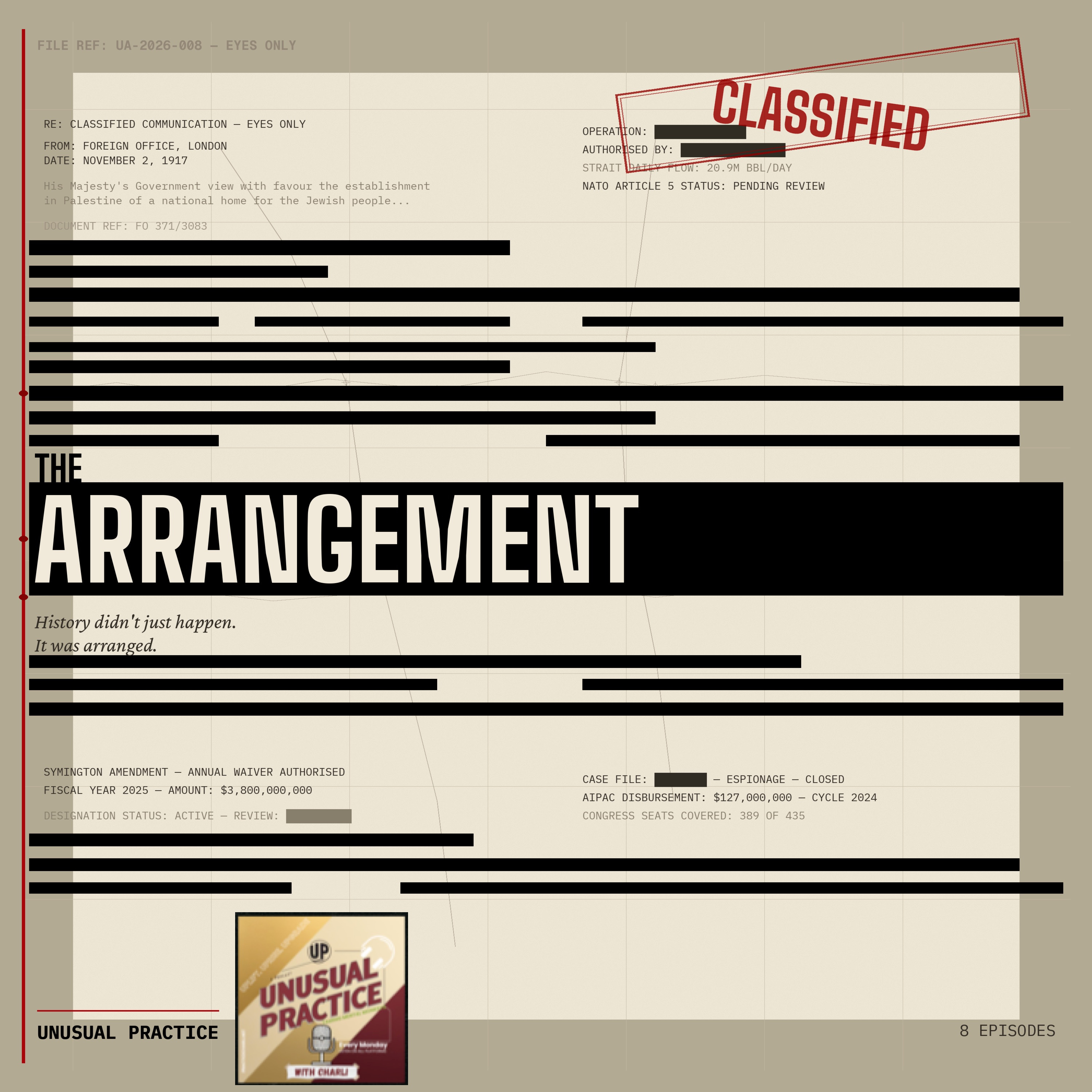
The Arrangement - The Chokepoint (Part4/8)
Part 4 of 8. Thirty-four miles wide. One fifth of the world's daily oil supply passes through it. When it closed, European gas prices jumped 70%, South Korea's stock market crashed 12% in a single day, and Russia counted its profits without firing a single shot.
In this episode of The Arrangement, a special 8-part series from Unusual Practice, we follow the economics of war: the Strait of Hormuz, why Europe's four-year effort to escape Russian energy dependency led them directly into another chokepoint, France's performance of principle versus its documented defence contracts, Spain's prime minister threatened within hours of saying no, and why America, which imports only 7% of its oil through the Strait, went to war over water it barely needs.
The real beneficiaries of this conflict are not the countries fighting it.
Sources:
1. Strait of Hormuz oil flow volumes — US Energy Information Administration
https://www.eia.gov/international/analysis/regions-of-interest/Hormuz
2. European gas storage levels February 2026 — European Commission Gas Storage
https://ec.europa.eu/energy/observatory/reports/gas-storage
3. Qatar LNG global export share — International Energy Agency
https://www.iea.org/countries/qatar
4. France defence agreements with Gulf states — French Ministry of Foreign Affairs
https://www.diplomatie.gouv.fr/en/country-files/gulf-cooperation-council/
5. Trump threat to Spain over war criticism — Reuters
https://www.reuters.com/world/trump-threatens-spain-economic-consequences-iran-criticism/
6. Russia oil revenue benefit from Middle East disruption — Financial Times
https://www.ft.com/content/russia-oil-revenue-hormuz-disruption
7. South Korea stock market crash — Bloomberg
https://www.bloomberg.com/news/articles/south-korea-kospi-hormuz-crash-2026
8. Petrodollar arrangement — Nixon 1974 Saudi agreement — Federal Reserve History
https://www.federalreservehistory.org/essays/oil-embargo
Visit our hub: https://unusualpractice.carrd.co Other site: https://unusualpractice.podview.com Main site: https://practicecharli.com
Support this podcast at — https://redcircle.com/unusual-practice/donations
34 miles wide. Roger Charlie, We're ready to rock. That is the width of the Strait of Hormuz at its narrowest. .34 miles of water between Iran and the Arabian Peninsula. 20.9 million barrels of oil pass through it every day. Like your comments? And subscribe. That is roughly 1/5 of all the oil consumed on earth every single day. Saudi Arabia, Iraq, the UAE, Kuwait and Iran, five of the world's largest oil exporters, all send their oil through the single waterway. There is no alternative. There is no pipeline that replaces it.
There is no other route. Unusual. Practice. We think what you think, you know. When the US and Israel launched strikes on Iran on February 28th, 2026, Iran's Islamic Revolutionary Guard Corps closed the Strait. Within hours, European natural gas prices began rising. Within days they had nearly doubled within a week, up 70 to 75%. South Korea's stock market suffered its biggest single day crash since 2008, Thailand imposed emergency trading curbs, India faced significant oil reserve shortfalls and Russia Russia counted its profits.
Welcome back to the Arrangement. I am your host, Charlie, and this is episode 4. We're entitling the choke point. This episode is about 34 miles of water and everything that passes through it and what it tells you about who this war is actually for when you follow the economics instead of the news. They say money can't buy happiness. Look at the fucking smile on my face.
To understand why the Strait of Hormuz matters more than almost any other place on Earth, you need to understand one simple fact about the global oil system. It has no redundancy. The world's most critical infrastructure, the network that heats homes, powers industry, fuels transport and generates electricity for billions of people, has a single point of failure. One narrow stretch of water controlled on its northern shore entirely by Iran, Saudi Arabia accounts for 38% of total hormones. Crude flows 5.5 million barrels per day.
Iraq 3.4 million, UAE 3.3 million, Kuwait 2.3 million, Iran itself 1.5 million. In 2025, approximately 78% of all Middle Eastern crude oil exports to China, Japan, South Korea and Taiwan flowed through the single choke point America's steak well. the United States itself imported only around 0.5 million barrels per day from the Persian Gulf through the straight, roughly 7% of total US imports. American shale production has made the US largely energy self-sufficient, so America is fighting spending blood and money in political capital to keep open a waterway that serves primarily its Asian competitors and allies, not itself.
That is not a foreign policy inconsistency. That is a deliberate strategic choice. The question is, who is it a strategic choice for? To understand what the Hormuz closure did to Europe, you need to remember what Europe spent the previous four years doing. After Russia invaded Ukraine in February 2022, Europe faced an energy crisis. It had been heavily dependent on Russian natural gas. The war made that dependency geopolitically untenable. So Europe scrambled urgently, expensively and under political pressure to find alternative energy sources.
The alternative they found, was LNG liquefied natural gas, primarily from Qatar. Germany signed key energy partnership agreements with Qatar. The Netherlands restructured its import infrastructure. Multiple European nations built or expanded LNG terminals specifically to receive Qatari gas. Qatar's main LNG exports facilities, Raslafan and Messiahed Industrial City, sit on the western coast of the Persian Gulf. Their exports exit through the Strait of Hormuz. When Iranian drones hit Qatari facilities in the first days of the conflict, Qatar halted production.
About 20% of global liquefied natural gas exports stopped. Europe had entered this crisis already. Dangerously exposed gas storage levels at the end of February 26th sat at 46 billion cubic meters, compared to 60 billion in 2025 and 77 billion in 24, running low before a single missile was fired In the first week of the conflict, European natural gas prices surged 70 to 75%. Dutch TTF and UK natural gas futures both spiked at levels not seen since the worst days of the Russia Ukraine energy crisis.
So here's the sentence that should be the headline of every European newspaper. It isn't. Europe spent four years and billions of EUR building an alternative to Russian energy dependency. It built that alternative directly through the Strait of Hormuz. Then someone bombed the Strait. Europe didn't escape energy dependency, it just changed landlords. And nobody told European citizens that their new energy security arrangement ran through a choke point that two countries, neither of them European, could close at will.
Most people are watching the war, a few are trying to understand it. This series is for the second group, 8 episodes. Every thread connected all sourced the arrangement only on unusual practice. When the strikes began, Europe's governments had to respond. Most issued careful diplomatic statements calling for de escalation. Macron did something different. France initially described the US attacks on Iran as dangerous for all and called for escalation to stop. That lasted approximately 48 hours. Then the Iranian drones struck a French naval base in the UAE.
Macron's tone changed immediately. He ordered the Charles Dugal aircraft carrier, France's only one, reposition from the Baltic Sea to the Mediterranean. He announced he was building a coalition to pool military resources. He declared it crucial that we ensure freedom of movement in the Strait of Hormuz. The pivot from critic to participant happened in 48 hours. The reason was not moral principle. The reason was documented in France's binding defense agreements with Qatar, Kuwait, the UAE, Jordan and Iraq.
France has military bases throughout the Gulf. France sells Rafael jets and naval frigates to Gulf states. France has contracts at risk. Macron condemned the strikes as outside international law and then shot down Iranian drones and self-defense, protecting the same allies those strikes were meant to protect. He is criticizing the war while fighting in it. That is not a contradiction in French foreign policy. Nope, That is French policy, the performance of independence, the reality of entanglement, and Spain.
Spain's Prime Minister Sanchez became the one European leader who refused. He condemned the strikes, called them outside international law and did not walk it back. Trump's response was immediate. Spain has been terrible. All business having to do with Spain. I have the right to stop it. One European leader says no to a war he considers illegal. The American president threatens his economy within hours. That is the relationship between American power and European sovereignty stated in plain English.
No analysis required. Just read what was said.
Now we come to the part of this story that almost no Western outlet is telling you, because telling you requires acknowledging something uncomfortable about the logic of this entire war. You see, Russia has not fired a single missile in this conflict. China has not moved a single soldier. Neither has spent a dollar. Neither has committed a troop. Neither has made a diplomatic statement that carries any real cost. Both of them are winning comprehensively, and they were patient enough to let America pay for it.
Here is how it works. Russia sells oil when Middle East oil is disrupted. When the Strait closes and Qatari LNG stops flowing, global oil prices rise. OK, Russia's oil is not constrained by the straight. Russia exports through its own pipelines and Baltic ports. Every barrel of Middle East oil that doesn't reach market is a barrel that Russia's oil, priced higher, can replace. The conflict in the straight is, for Russia, a revenue event. China buys oil. China has spent the last three years building the most sophisticated sanctioned oil import network in history.
Russia, under sanctions since 2022, sells its oil to China at significant discount because it has no other buyer. Iran, under sanctions for decades, sells its oil to China at discount. Venezuela, under American sanctions, sells to China at discount In 2024, Russia, Iran and Venezuela combined accounted for 33% of China's entire crude import mix. Three countries under American sanctions all selling to China at below market prices because America's sanctions policy has accidentally created a permanent discount oil supply for its principal strategic competitor.
Every sanction Washington imposes on an oil producing nation enriches Beijing, and every military escalation that disrupts Middle East supply pushes Asian buyers who can't absorb the Hormuz closure toward Russian supply at elevated prices. Russia profits from the war. China profits from the sanctions. America spends the money and the lives and the countries paying the highest price and economic damage, South Korea, Japan, Taiwan, Germany, all America's allies, not its adversaries. So we cannot discuss the straight without discussing Saudi Arabia, because Saudi Arabia's role in this crisis is the clearest evidence that nobody involved is behaving according to the principles they publicly claim.
Saudi Arabia is publicly presenting itself as a victim of Iranian aggression. Iranian missiles struck Saudi facilities. That is documented and real. Saudi Arabia has legitimate security concerns about Iran. Those are also real. And simultaneously, in the weeks before the February 28th strikes, Saudi Arabia was moving oil at a furious pace out of the Gulf, filling strategic reserves in the Red Sea, the Netherlands and South Africa, prepositioning for a supply disruption. They knew this was coming.
They prepared for it. A country that is genuinely surprised by a war does not preposition oil reserves on three continents before the first shot is even fired. And Saudi Arabia's deeper calculation sits underneath the oil. The Petro dollar arrangement, the agreement under which Saudi Arabia prices its oil exclusively in U.S. dollars, is the foundation of American financial dominance. As long as the world buys oil in dollars, the world needs dollars. The world needing dollars is what allows America to run perpetual deficits, maintain global military presence, and enforce financial sanctions without equivalent economic pain to itself.
Saudi Arabia's power in this arrangement is not its oil, it is its pricing currency. If Saudi Arabia priced oil in one, as China has been quietly pushing for, the dollar loses its reserve currency status. The American financial system faces a structural shock it has never experienced. This is why America maintains military protection for an absolute monarchy that has no elections, no independent judiciary, and executed 72 people in a single day in 2022. Not because of shared values, because of shared currency architecture.
The relationship is transactional. Both sides know it. Neither side says it. Before we close this episode, I want to come back to the person who is never in these calculations, the person who doesn't appear in the Ledger of strategic interests and petrodollar arrangements. The German family opening their heating bill in March 2026, finding it 70% higher than it was two months ago. They did not vote for this war. They were not consulted about the Hormuz closure. They have no relationship to the decisions made in Washington or Tel Aviv or Tehran.
They are paying for an arrangement. They were never part of the Korean factory worker whose company stopped production because the supply chain runs through the Strait and the insurance on those ships became unaffordable overnight. South Korea's stock market lost 12% of its value in a single day, the worst single day fall since 2008. The Indian family facing food price inflation driven by the spike in transport fuel costs. India faces significant oil reserve shortfalls. A country of 1.4 billion people whose energy security runs through waters controlled by a conflict they had no part in creating.
And the people of Gaza, Lebanon, Iran, Yemen, whose lives, homes and futures are the actual battlefield of this arrangement? None of them were in the room when any decision that led to this was made. Not the Balfour Declaration, not the Sykes Picot agreement, not the AIPAC funding architecture, not the Symington Amendment waiver, not the handshake in Riyadh, not the Hormuz closure, None of them. Every decision made in rooms they were never allowed to enter. Every bill sent to addresses that were never consulted.
Don't forget to like and subscribe.
All right, we're 4 episodes in. Let's account for what we now know. And guys, thanks so much for your emails. It is motivating me to move ahead. So we started with a letter with 67 words written by a man with no right to promise what he promised. We followed the money 300 billion dollars 127,000,001 election cycle and a law waived every year for one country. We watched the word terrorist get assigned, removed and reassigned according to strategic convenience. An Al Qaeda fighter got a presidential handshake while people in Pakistan and Somalia got drone strikes.
And now we followed the water 34 miles that connected a war in the Middle East to gas bills in Germany, stock markets in Seoul and profit statements in Moscow.
And subscribe. Every source cited in this episode is documented and LinkedIn the description. Now in episode 5, we go to the room that nobody invites you into. Jordan's secret, the Arab world's performance and the back channel reality underneath it. And Saudi Arabia's oil, the weapon that's also a hostage. The Arab brotherhood was always an unfortunate performance. Episode 5 is where we prove it. And if you think that's the most uncomfortable truth in this series, well, listen up, buttercup. This was the unusual practice with a series called The Arrangement.
Because history didn't just happen, it was actually arranged. Don't forget to like, follow, share and comment. I truly look forward to them. Tomorrow we drop episode 5 and 6.
Somebody just followed me.
 Apple Podcasts
 Castbox
 Castro
 Goodpods
 Moon FM
 Overcast
 Pocket Casts
 Podbean
 Podcast Addict
 Podcast Republic
 Spotify
 YouTube