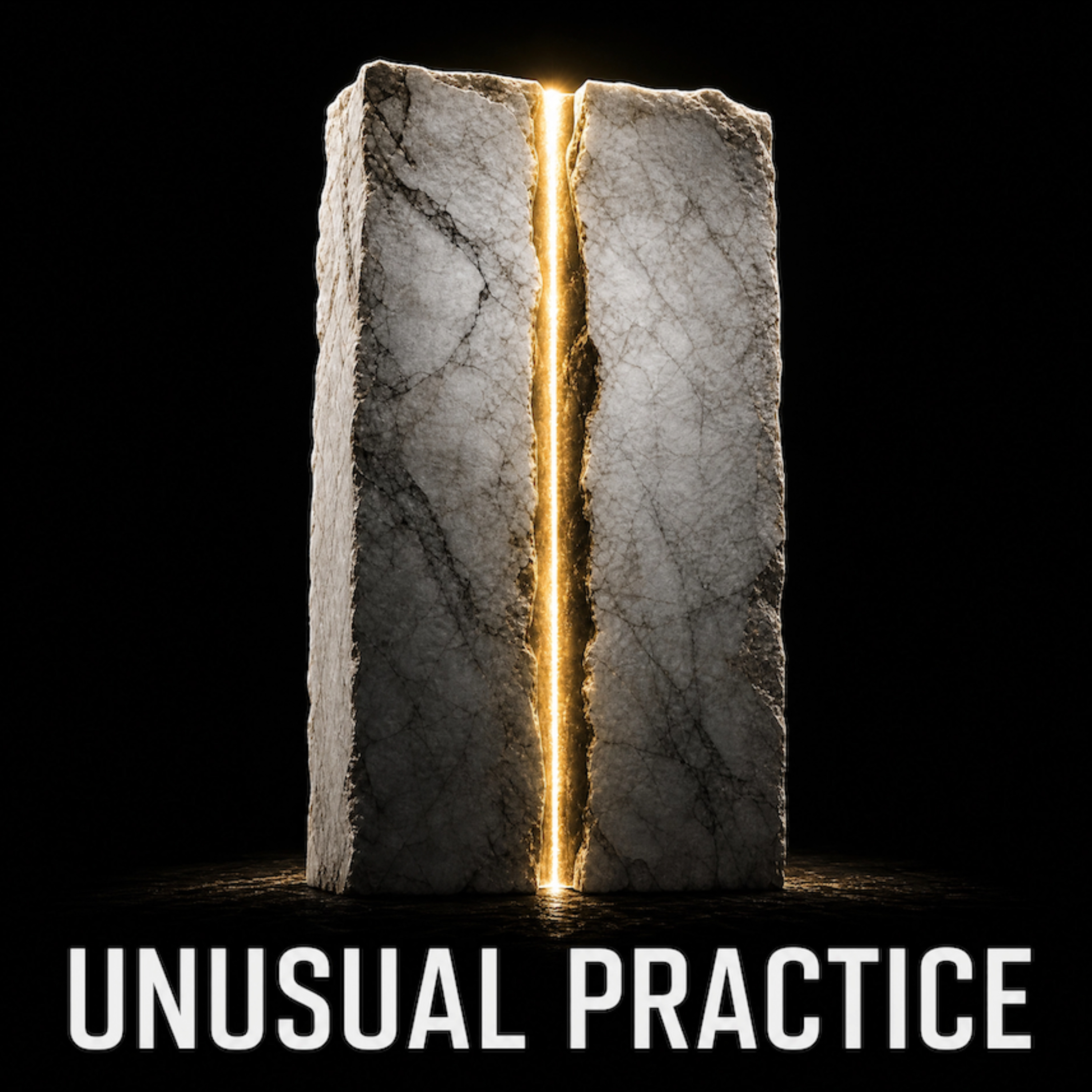
Why most people don’t actually want Freedom
Why do people who say they want freedom keep asking for permission?
This episode breaks down the psychology of freedom: why genuine autonomy is rarer than we think, why rebellion isn't the same as freedom, and what it actually costs to stop outsourcing your choices.
From Erich Fromm's Escape From Freedom to Milgram's obedience experiments, we dig into the uncomfortable truth: most people don't want freedom. They want safety, validation, and someone else to blame.
If you've ever felt trapped by a life you technically chose, this one's for you.
Visit our hub: https://unusualpractice.carrd.co Other site: https://unusualpractice.podview.com Main site: https://practicecharli.com
Support this podcast at — https://redcircle.com/unusual-practice/donations
Roger, Charlie, we're ready to rock.
Here's something you have definitely said, or someone you know has said it, or it's sitting in someone's Instagram bio right now next to a photo of them at a coffee shop doing absolutely Jackal. Nothing risky, I just want to be free. Aw, that is classic. It's beautiful. Also, almost certainly a downright lie. Not a malicious lie or a comfortable one, just the kind you tell yourself so convincingly that you start to believe it. You see, the human brain is genuinely spectacular at this. This is Charlie.
Like. Comment and subscribe because here's what the I Just Want to Be Free crowd is actually doing. They're asking what's acceptable before they act, watching what everyone else orders before they decide, and waiting for the trend to validate the thing they already wanted to do. The jig is up y'all. They need three people to cosign an idea before they can commit to it. Posting them refreshing for 45 minutes to see if it lands. That is not freedom. That's freedom with a cosigner. Smash the like button.
Yeah, before you get defensive, this is not a character flaw. It is a design feature, believe it or not. The problem is we've dressed it up in the language of liberation and sold it to ourselves like it's the same thing. We don't want freedom. We want permission without feeling controlled. And here's the hug that makes it genuinely uncomfortable. Freedom doesn't just give you options, it removes your excuses. When you're truly free, you can't blame the system, the boss, the algorithm, your parents, your Zodiac sign.
You own all of it. Every outcome, every missed opportunity, every choice you did not make.
And it turns out that is a lot. Most people would rather not hold that much, so we built something to help. The beautiful, socially approved illusion of rebellion. Unusual practice. Deeper than a TikTok, tighter than a book. Rebellion and freedom are not the same thing. They're not even close, though a lot of people seem to make it sound like they are. Rebellion has a landlord. It rents space from the very thing it is fighting. A rebel's entire identity is defined in opposition, which means the authority they're rebelling against isn't just their enemy, it's their anchor.
Remove the authority and the rebel has nothing to stand on. The punk rocker needs the corporate machine. The contrarian needs the mainstream rebellion says you can't tell me what to do. That sentence still contains you. It still requires the other person to matter. Freedom, on the other hand, says you're irrelevant. That's the line that socially unravels people. Because you're irrelevant does not start a fight. It actually ends one. It walks out of the room and doesn't look back. Eric Frum figured this out in 1941, while fascism was spreading across Europe like a fever.
He found that when people are freed from traditional authority, many of them actively seek new forms of submission. Not because they're forced to, because they want to. One authority collapses and people Sprint toward the next. One different packaging, identical function. You've watched this happen in real time. The people loudest about questioning everything. Look what happened when their tribe settled on an answer. Questioning stopped. Orthodoxy resumed. If your identity depends on pushing against something, you're still attached to it like a shadow.
You're on the opposite side, but you move in exact proportion to the thing you're supposedly escaping. Stop the swipe. You're a builder, not a gambler. Most apps are built to waste your time. We built ayoumypartner.com to save it. One photo, 1 manifesto, 1. Clear intent, high level business, real friendship, ambitious romance. Go to rumypartner.com. Efficiency is the only luxury that matters. Find your alliance. Here's the actual cost of freedom that nobody puts in the damn brochure. When you're truly free.
No ideology to follow, no tribe to defer to, no cultural script to run. You do not have a scapegoat, no villain, no one to hand your failures to. Everything lands on you. And psychologically, most humans find a restrictive structure more bearable than genuine uncertainty. Not just uncomfortable, more bearable. They'll actively choose less freedom if it comes with more predictability. Milgram's obedience experiments found this so universally that he abandoned his original plan to compare Americans to Germans because the results suggested something that transcended nationality.
Cross cultural replications showed the foreign obedience rate was actually higher than the American one, 65% versus 61%. Some countries hit 90%. That's not a data point about evil. It's a data point about comfort, about what people reach for when uncertainty gets heavy enough. And uncertainty is the defining condition of genuine freedom. Barry Schwartz documented this quietly devastating fact. Modern people have more freedom of choice than any group in human history, and they are less satisfied because of it.
More options equals more anxiety. And here's the darkly funny part. People were burning their entire freedom budget on which show to stream and which coffee to order, leaving nothing left for the decisions that actually mattered. Who to love, how to live, what to stand for. We're using the budget on the wrong line items the rules you find oppressive are doing a second job you never thank them for. The schedule you hate is also the reason you're not paralyzed every morning about what to do next. By the way, the career path someone else expects you to follow is also an excuse to avoid the harder question.
What do you actually want?
You see, rules feel oppressive, but they also feel stabilizing. That's not a contradiction. That's the architecture of how most people quietly survive. You also stop to pander by how huge the universe is and how insignificant we really are. There's a new currency running through every conversation you have online. Not clout, Not reach permission. Invisible constant micro approval. Like is this OK to say? Is this problematic? Is this aligned? Has enough time passed for this take to be safe? If the social math doesn't add up, you swallow the opinion you post something calibrated instead something safe, right?
Solomon Ash found this in 1951, before single algorithm existed. When participants faced a group giving an obviously wrong answer, 37% conformed anyway, even when the correct answer was right in front of their face. When interviewed afterward, most said they didn't believe the group's wrong answer. They complied anyway, for fear of being thought peculiar in a room with strangers over the length of lines on a piece of paper. Now put those same people online where the stakes are their career, their community, their livelihood, and calling it a free marketplace of ideas becomes almost comedy.
Social media added one thing as never could have designed in permanent record. The terrified participant in 1951 got to go home and just forget about it online. The wrong opinion follows you forever. The permission economy doesn't just filter what you say, it filters what you think. People stop forming opinions that haven't been pre cleared by the group. And here is why. It's physically hard to resist. Disapproval at the neurological level registers as a real threat. Research shows the brain processes social rejections through the same circuitry it uses for physical pain.
Expressing an unsanctioned opinion doesn't just feel awkward, it actually hurts biologically, in ways, the body reads as danger. Freedom is quiet. Rebellion is loud. Quiet because the decision doesn't get a standing ovation. Quiet because sometimes the only proof you made an autonomous choice is that no one endorsed it and you did it anyway. Here's what genuine freedom actually strips away, and why it's so rarely chosen. Validation. There's no longer a group endorsing your choices. No tribe nodding, no algorithm rewarding your positioning.
Moral cover belonging to an ideology, movement, or social aesthetic gives you moral scaffolding. You don't have to build an ethical position from scratch because the group supplies one. Strip the group away and you have to think for yourself about what is actually good, what is actually right, and why. Without the safety net of consensus. That is, frankly, exhausting. And then there's applause. There is no prize for being autonomous, no ceremony. The actual sound of genuine freedom is often quiet, occasionally lonely, and sometimes just nothing.
Jean Paul Sat put his finger on this with characteristic briskness. Bad faith in his framework involves denying your own freedom and responsibility, attributing choices to external factors or social norms. He illustrated it through the figure of the waiter who performs his role with such excessive precision that he erases his freedom to choose a different path. The role consumes the person, and most people don't want autonomy, they want safety plus admiration. They want to be seen as someone who thinks independently by a group of people who agree with them.
Because what it describes is freedom as a brand, autonomy as a curated aesthetic, which is almost perfectly the opposite of the thing it claims to be. Unusual practice. We read the studies you pretend to quote. We question everything, especially the experts. It's the show that does the research so you don't have to, and saves you from another Ted Talk while we're at it. Unusual practice, we're thinking. Still a thing? So let's be specific about the real bill. If you are genuinely free y'all, you will disappoint people.
Not as a risk, as a mathematical certainty. When you stop organizing your choices around what other people need you to be, you will fail to be what someone needed, and they will not thank you for it. You won't be fully understood the moment you hold an opinion that contradicts your box. People don't update the box. They get confused, then suspicious, then quietly hostile. You haven't necessarily changed, you've just violated the contract they wrote for you without even telling you. You won't fit cleanly into any tribe, and in 2026, tribes are not optional.
They are the primary unit of social organization on every platform, in every community, increasingly in every workplace. To be genuinely autonomous is to be slightly eligible to all of them simultaneously. This is not a modern problem. And Confucian influence societies, China, Japan, Korea, Vietnam. The concept of mianzi describes the social face maintained through collective harmony, not individual expression. The person who insists on private truth at the cost of group peace is not celebrated.
They are managed quietly, move toward the edges. In Amish communities, shunning Maidong is total. No conversation, no acknowledgement, no eye contact. Because in a community where social belonging is your entire infrastructure, your work, family, housing, economy, exclusion isn't symbolic. It's existential. Our ancestors who broke from the group didn't just feel lonely, they often died. The nervous system hasn't received the update that says we'll survive disapproval now. But here's the thing. We're not on the Savannah anymore.
We can survive it. We can find new communities, and we can build lives that don't require the original group's consent. The cost of actual freedom is real, guys, but it's no longer fatal. People prefer belonging to autonomy not because they're weak, but because belonging was, for a very long time, survival. That history is written so deep in the body that a podcast or a philosophy book or a personal epiphany does not simply overwrite it. Freedom is available. The invoice is real, though, and most people, once they see it clearly, make a quiet and entirely reasonable calculation.
They choose the group and then tell their friends they just haven't found the right time to break free yet. For those of us climbing to the top of the food chain, there can be no mercy. There is but one rule. Hunt or be haunted. All right, So what does the alternative actually look like? Well, it's not chaos. Not quitting your job and posting about it. Not living authentically in a yurt with a ring light. Real freedom looks like owning your decisions, not the convenient ones. All of them. It looks like accepting consequences as information, not punishment.
Every outcome tells you something about the choice that produced it. Most people skip this part. They experienced the consequence. Find something external to explain it and move on. Without updating anything, it looks like not outsourcing your judgment. Not to the trend, not to the tribe, not to whoever's loudest, the hardest, or the hard version of this isn't disagreeing with strangers, it's disagreeing with the people whose approval you actually care about. And that is the test. Viktor Frankel, not a self help author, a Holocaust survivor, said something structurally different from think positive.
He said everything can be taken from a man, but one thing, the last of the human freedoms to choose one's attitude in any given set of circumstances, to choose one's own way. One thing in Auschwitz with nothing left. That's not a motivational quote. That's a man who lost his wife, his family, everything external, and discovered that something remained, that no system, no structure, no regime could confiscate. Not happiness, not comfort. The capacity to choose his response. Therefore, between stimulus and response, there is a space.
In that space is your freedom. Not in the dramatic gesture, not in the performance of liberation, in the moment between what happens to you and what you do next. Freedom isn't doing whatever you want, it's owning what you choose. Within freedom lies responsibility, including the choice to follow rules, including the choice to belong. Freedom doesn't belong only to people who've escaped all constraints. It belongs to anyone who stops pretending the constraints chose themselves. So here's where we land.
Not with an answer, with a question you have to actually sit with. If you were truly free. Not performatively free. Not oppositionally free. Not free adjacent because you wear the right T-shirts and share the right opinions. But actually free, with no scapegoat, no group cover, no external script to hide behind. What would you stop blaming? Smash the like button.
What would you stop blaming? Not in a cruel way, but in an honest one. Because that list? The things you're currently using as an explanation for where you are and why you haven't done the thing you know you should do. That list is the shape of a cage that doesn't have anyone else's name on it.
The job you haven't quit. The relationship you haven't left. The work you have not started, the conversation you have not had, The version of yourself you've been field testing for six years and still haven't committed to. The economy didn't do that. The algorithm didn't do that. Your childhood, real and formative as it absolutely is, is not still making the daily decisions you are, which is either the most terrifying thing anyone has said to you today, or the most freeing, probably both. And that's how you know it's real.
Freedom is not a destination you arrive at and unpack your bags. It's not a level you unlock. It is a practice, a daily, unglamorous, quietly radical practice of choosing deliberately how you respond to what life sends at you. You don't have to blow up your life to start, you just have to stop waiting for permission to live the one you already have. So start small on one decision today that you'd normally soften with. Well, the situation kind of forced me to say the thing you'd normally pre approve with three people.
Make the call. You've been outsourcing to fate. Radical, simple, terrifying. Yours. All right, that's it for today, guys. If this episode made you uncomfortable, good. That means it worked. If it made you feel seen, text it to the person in your life who needs to hear it and absolutely will not take it well. And that's the most loving thing you can possibly do for them. Subscribe, follow, leave a review. And if you don't, I'll assume you're still waiting for the group to decide if that's a good idea.
Yeah, which honestly tracks. Share this with someone who says they hate rules but hasn't made a single unilateral decision in six months. You know exactly who that is. Until next time, stay curious, stay honest, and for the love of everything, stop asking for permission. Mom, somebody just followed me and we say bye. Bye.
 Apple Podcasts
 Castbox
 Castro
 Goodpods
 Moon FM
 Overcast
 Pocket Casts
 Podbean
 Podcast Addict
 Podcast Republic
 Spotify
 YouTube